
The modern form of き comes from the cursive form of the kanji 幾 (き, ki, i.e.: “how many”, “some”, etc.). Follow the progression of the different scripts shown in Figures 1 to 3 to understand its origin.
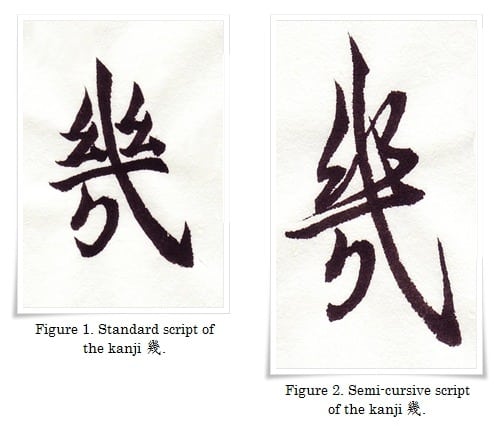

figure_1_2_hiragana_ki-horz

Figure 1. Standard script (楷書, かいしょ, kaisho) of the kanji 幾. Calligraphy by 品天龍涙 (ぽんてりゅうるい, Ponte Ryūrui), ink on paper.

Figure 2. Semi-cursive script (行書, ぎょうしょ, gyōsho) of the kanji 幾. Calligraphy by 品天龍涙 (ぽんてりゅうるい, Ponte Ryūrui), ink on paper.
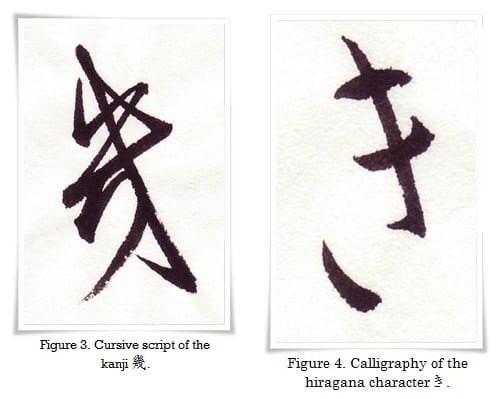
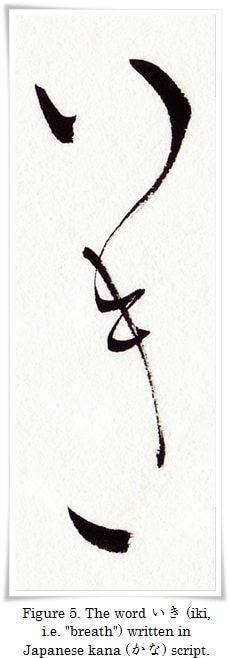
figure_3_4_hiragana_ki-horz


figure_5_hiragana_ki

Figure 3. Cursive script (草書, そうしょ, sōsho) of the kanji 幾. Calligraphy by 品天龍涙 (ぽんてりゅうるい, Ponte Ryūrui), ink on paper.

Figure 4. Calligraphy of the hiragana character き. Note the corresponding shape with the cursive form of the character 幾 (Figure 3). Calligraphy by 品天龍涙 (ぽんてりゅうるい, Ponte Ryūrui), ink on paper.

Figure 5. The word いき (iki, i.e. “breath”) written in Japanese kana (かな) script. The hiragana character い is based on the cursive form of the kanji 以 (い, i, i.e. “by means of”, “because of”, etc.), which is explained in this article. Calligraphy by 品天龍涙 (ぽんてりゅうるい, Ponte Ryūrui), ink on paper.

About: Ponte Ryūrui (Posts: 120)

Ponte Ryuurui (品天龍涙, ぽんてりゅうるい, Ponte Ryūrui) is the pen name of Piotr Ponte L. Sypniewski. He began studying calligraphy in 2001 under Japanese Master Kajita Esshuu (梶田越舟, かじたえっしゅう, 1938 – present). Ryuu has abandoned his legal profession in order to devote his entire life to the art of Chinese and Japanese calligraphy. He is a published poet and writer, a calligrapher, ink painter and scholar.


Tagged with →  
  • Sergey

    Thank you very much for the articles on hiragana etymology!!!
    Now (as I am familiar with hiragana) it is much easier for me to understand cursive style for many characters)))).

  • http://www.beyondcalligraphy.com Ponte Ryūrui

    You’re welcome, Sergey. Cursive script is like a jungle at night; so many sounds, but hard to tell where they are coming from, and where they are going to. I am glad that our posts assist you in studying. I am considering writing one about cursive script alone, or perhaps, a series of posts on that subject. You can also read about cursive script on our main page, here: http://www.beyondcalligraphy.com/cursive_script.html

Upcoming Events – North and South America

April 25, 2013
New York, NY, United States
Chambers Fine Art is pleased to announce the opening on April 25, 2013 of Cui Fei: Tracing the Origin, her first solo exhibition at the gallery. A graduate of the Zhejiang Academy of Fine Art in Hangzhou, China, she moved to the United States in 1996 and has been resident here ever since. Although she [...]

Upcoming Events – Asia, Australia and Oceania

May 14, 2013
Taito, Tokyo, Japan
Except for China, Japan preserves the most Chinese paintings in the world. This is because, during a thousand-year period of exchange with China, Japanese people have cherished and carefully passed on Chinese paintings. With a focus on the Edo period, this exhibition shows how treasured Chinese paintings (which were known as kara-e at the time), [...]

Upcoming Events – Europe, Middle East, Africa, and Greater Arabia

September 14, 2013
Budapest, Budapest, Hungary
Event: 2nd Momiji Shodokai Annual calligraphy meeting following the traditions of Kakizome with group and individual performances, calligraphy activities and free tehon handouts. The event is open and free! All are welcome to join in: beginners, more advanced practitioners, professionals, art lovers, passer-bys, dogs and cats Beginners will get professional help in creating their own [...]